M3.3 Environmental Justice
The study results shown from Bullard & Johnson (2000) showing the disparity of landfill location in African American communities as opposed to white communities is discouraging, but not surprising. This seems to be true for many of the articles we've seen throughout this class thus far. Environmental hazards continue to disproportionately affect specific populations - people of color, people below the poverty line, and uneducated individuals. The distinct placement of landfills in areas concentrated with people of color alludes to the idea of environmental racism. Bullard et al. (2000) show the disparity against African Americans, but the problem also exists for other people of color, not just the black community. The activist group "Black Lives Matter" fight against racial injustice and violence against African Americans, but the concept also should extend to all racism which exists in our society today.

Cities may choose to place landfills or greater environmental hazards in lower income neighborhoods usually because the cost may be cheaper and there is less likely to have pushback from the community either due to lack of time, money or education. This also touches upon the fact that social determinants is a huge factor even in environmental justice leading to overall health. The one encouraging factor is that there is a specific Environmental Justice Office under the EPA to ensure that these problems are not quite as rampant.
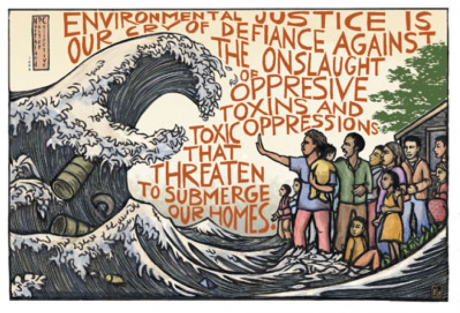
Cities may choose to place landfills or greater environmental hazards in lower income neighborhoods usually because the cost may be cheaper and there is less likely to have pushback from the community either due to lack of time, money or education. This also touches upon the fact that social determinants is a huge factor even in environmental justice leading to overall health. The one encouraging factor is that there is a specific Environmental Justice Office under the EPA to ensure that these problems are not quite as rampant.

I agree that these findings are not surprising. It seems like in almost every aspect, our society perpetuates socio-economic disparities. I am curious to hear if you have an opinion regarding the level of responsibility more protected groups have in ending environmental discrimination?
ReplyDeleteHi Maggie and Sabrina, I agree that the findings are not surprising as we would have seen a couple of years ago. With the landfills causing hazards in lower income neighborboods, these community do not have a strong public health voice in preventing the environmental discrimination from continuing. It's a matter of increasing awareness and educating those who are not of the same social class and are not faced with this daily hazard to ultimately drive change.
Delete